Here are the articles for the week of March 14th. Choose one of the articles to read.
Remember each current event should contain the following
Heading: Name, block, date
Citation: Author (last name, first name), Title (in quotes), name of journal/newspaper/publication (underlined), and date the article was written
Summary: 60-100 word summary, summarize key points found in the article
Response: Add your opinion on the article. What did you find interesting or not interesting? Did the information in the article impact your life?
4 Questions: Write questions that came up for you while you read the article. These are not questions answered in the article and you do not need to answer them.
Choose one article:
Japan Tsunami
Sea Change
Moonquake March 16th
Google Person Finder
Sunday, March 13, 2011
Wednesday, March 9, 2011
Earthquakes and Tectonic Plates
How do different Tectonic Plate Boundaries effect earthquakes.
Use these link
Exploring Earth
Forces of Nature
Use these link
Exploring Earth
Forces of Nature

Tuesday, March 8, 2011
Evidence of Plate Tectonics
Seafloor Spreading
Today we will create a model to represent a seafloor that is expanding as new rock is being pushed up from the mantle.
If you missed class watch this video: Seafloor Spreading
Answer the questions on the back of the activity sheet.
Fossils, and Glaciers
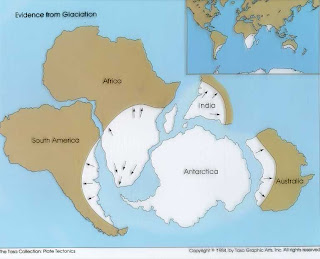
Glaciers once covered areas that today are very warm. These large sheets of ice carved out the landscape on these continents.

Today we will create a model to represent a seafloor that is expanding as new rock is being pushed up from the mantle.
If you missed class watch this video: Seafloor Spreading
Answer the questions on the back of the activity sheet.
Fossils, and Glaciers
Glaciers once covered areas that today are very warm. These large sheets of ice carved out the landscape on these continents.

Fossils of prehistoric plants and animals have been found on continents that today are separated by oceans.

Monday, March 7, 2011
Pangaea
About 200 million years ago scientist believe that all the continents where conected and formed a super continent called Pangaea, greek for "all lands." As the Lithosphere cracks and moves over the weaker Asthenosphere, the continents have shifted.


Sunday, March 6, 2011
Current Event Articles: March 7,2011
Here are this weeks current event articles. Choose one to read, summarize, and respond to. Come up with four questions that you think about while reading the article. Not questions that are answered in the article. Hand in your current event at the beginning of class on Thursday.
Plants to Plastic
Arkansas Earthquake
Cell Phones and Your Health
Earth Rocks On
Plants to Plastic
Arkansas Earthquake
Cell Phones and Your Health
Earth Rocks On
Thursday, March 3, 2011
Types of Plate Boundaries
Plate Boundaries occur where two Lithospheric Plates meet. The theory that describes the movement of these plates is known as Plate Tectonics. These boundaries are called Diverging, Converging, and Sliding boundaries.
When two plates can be moving away from each it is called a Divergent Boundary. When two plates move toward each other it is called Convergent Boundaries.
Oceanic Divergent Boundaries


Convergent Boundaries, oceanic/continental

Convergent Boundaries, Oceanic/Oceanic

Convergent Boundaries, Continental/Continental

When two plates can be moving away from each it is called a Divergent Boundary. When two plates move toward each other it is called Convergent Boundaries.
Oceanic Divergent Boundaries

Continental Divergent Boundaries


Convergent Boundaries, Continental/Continental

Wednesday, March 2, 2011
Plate Tectonics
Plate Tectonic Vocabulary
In the following days well define each of the following terms:
Lithospheric Plate
Plate Tectonics
Continental Drift
Seafloor Spreading
Diverging Boundaries
Sliding Boundaries
Converging Boundaries
The Earth's crust is rigid and when it moves cracks and fissures are formed. Much like when you crack a hard boiled egg shell. The pieces of the crust fit together like a giant puzzle. There are 8 major lithospheric plates and several smaller plates. We are going to put the pieces of the puzzle together and label the major plates. The directions these plates are moving create many of the landscape feature that we see all around us.
Use this image to label the 8 major plates

In the following days well define each of the following terms:
Lithospheric Plate
Plate Tectonics
Continental Drift
Seafloor Spreading
Diverging Boundaries
Sliding Boundaries
Converging Boundaries
The Earth's crust is rigid and when it moves cracks and fissures are formed. Much like when you crack a hard boiled egg shell. The pieces of the crust fit together like a giant puzzle. There are 8 major lithospheric plates and several smaller plates. We are going to put the pieces of the puzzle together and label the major plates. The directions these plates are moving create many of the landscape feature that we see all around us.
Use this image to label the 8 major plates

Subscribe to:
Posts (Atom)